
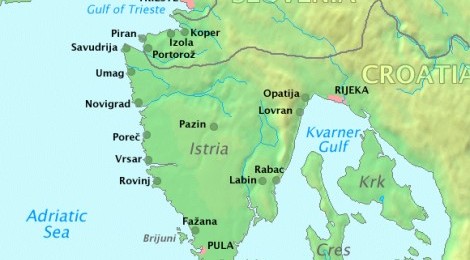
Italianization of surnames in Istria region
Genealogists interested in finding out genealogical data about inhabitants of Istria, the largest peninsula in the Adriatic Sea (now shared by three independent countries – Croatia, Slovenia and Italy), may find themselves in wonder.
Between 1918 and 1930, greater number of peoples (primarily Croats and Slovenians) living in that region were subject of a forced italianization by local Italian government authorities which particularly reflected in first and last name changes.
Criteria for the change varied from case to case. Sometimes, a perceived meaning of a surname in Slavic languages was a subject of a literal translation into Italian. Examples of that were surnames Goranc changed into Monti, Czar into Cesari, Ribarić into Pescatore etc.
If a surname didn’t have a concrete meaning in the source language, it was italianized by phonetical change, shortening and prefix/sufix alteration. For example, surnames like Matulić, Mihaljević and Mudrušan were changed into Mattioli/Matiolli, Micagli/Micali/Micalli and Modrussani.
Italianization of Croatian, Slovenian, German and Hungarian surnames was so comprehensive that it is estimated that about 75 percent of all family names in that area didn’t survive in the original form.
So, persons who perform a genealogy research of families from Istria should try to figure out if the change actually occur and if it did, they should find out what was the original form of the surname.
A comprehensive list of surnames in source form and their italianized counterparts can be found in the book “L ‘identita cancellata” (“Deleted identity”) by Paolo Parovel, published in Italy in 1985, then translated and republished in Croatia in 1993. under the name “Izbrisani identitet”.

I am very interested in knowing more about the history of surnames and their possible change post war. I have been told that my fathers name (Sodomaco) may have actually been something like Sedmac or Sedmak and my mothers name (Mauri) may have been Mauric or Maurich. Not having easy access to records in Australia, I would be keen for some guidance on how to validate or otherwise such facts.
Steve Sodomaco
that is so totally rubbish, that our surnames were italicized its the other way around, our Italian names were changed to suit the Slavs, why do people tell so many fabricated lies i will never know, i know what my parents were put through during and after the war, i will never be a Croatian or a Slovenian, even though my papers say otherwise in my heart and soul i know what i am and you cant erase that my mother tongue is Italian and always will be till the day i die,
Hi, Iam also very interested about this subject. There is no information about italian heritage or stemma about my family. I believe that my Family (Tottene) have bem origined from Instria or Croatian states.
I want to know italian surname for radic
My surname is Lauri. I’ve had my DNA tested and it shows North Eastern Italian and Croatian/Slovenian links going back a few hundred years. My great grandfather was actually born in Messina Sicily and moved to Malta where the Lauri surname is quite common, but I’m wondering if his ancestors came down to Sicily from the North Eastern Italy and/or Croatia/Slovenia regions. Does anyone have any info on my surname? (I’m from England)
My grandfather’s last name was changed in 1929 and rather than Italianize a Slavic sounding name, he adopted my grandmother’s name which was clearly Italian. This of course reflected the rise of Italian nationalism and related policies. Interestingly, he changed it back in 1956, but chose to keep the Italianized spelling rather than the Slavic one (I.e. ending of “vich” vs “vic” and no “j” put back into the name). This reflected a time when Yugoslavia was more certainly getting possession of Istria and the Italian schools, churches and so on already changed to ensure no Italian spoken. My parents had to learn Croatian and were fortunate to live in an Italian speaking town that was heavily anti-fascist.
It was fascinating for me to find my grandfather’s application reply letter sent to Yugoslavia for him to be considered an Italian citizen (for repatriation to Italy I assume), but the reply stated that his mother tongue wasn’t Italian (though it was). That was just before the name change in 1956.
Love my homeland Croatia and proud of my 500 years of Istrian heritage.
I’d like to know what surname that is italian means then? I did my dna…im Croatian. Nit Italian like I’ve thought my whole life. None. Only Croatian, German, portugese….but no Italian. How did my grandfather and great grandparents whom I thought were 100% Italian get their name tgen?